
The Perfect Trifecta: Why Connection, Community, and Health Benefits Are a Win Every Time
Estimated Reading Time: 9 to 10 minutes
At a Glance
In Part 1, we explored Purpose and Intention, Pillar #1 of your Encore. Now we turn to Pillar #2: Community and Connection and look at why they matter at in your Encore.
These are not “nice-to-haves.” They are essential. The research is compelling and has captured the attention of the World Health Organization. Strong social connections are as vital to health as diet, exercise, and maintaining healthy biomarkers like blood pressure, glucose, and cholesterol.
The impact of social isolation on mortality has been compared to smoking fifteen cigarettes a day. The elements of this pillar are considered protective factors that support brain health, mental wellness, and longevity.
What Research Says About Community and Connection
The evidence linking social connection to health outcomes is overwhelming. I n 2024, governments from around the world, including Japan, Morocco, Sweden, Kenya, and Chile, issued a joint statement highlighting the importance of social connection to the health and well-being of individuals, communities, and societies.
The World Health Organization has gone so far as to label loneliness a global epidemic.
A lack of social connection increases the risk of premature death by 26 to 29 percent and is strongly linked to higher rates of heart disease, stroke, dementia, anxiety, and depression. That statistic stopped me in my tracks.
When I looked deeper, the causes were not especially surprising. The rise in single- person households. More people are working remotely. Declining participation in faith-based and community groups. And of course, social media.
Still, it is hard to believe that loneliness has reached epidemic levels. I wonder if that surprises you too.
The research is consistent. People who frequently feel lonely are more than twice as likely to develop depression compared to those who rarely feel lonely.
Social connection affects brain structure. Higher levels of social engagement in older adults are associated with greater total brain volume and healthier gray matter in regions responsible for social understanding. The “social brain” quite literally benefits from connection.
Strong social ties save lives. Individuals with meaningful relationships have a 50 percent greater likelihood of survival than those with poor social connections. This impact is greater than physical inactivity and obesity and comparable to smoking fifteen cigarettes a day. Social isolation alone is associated with a 35 percent increase in mortality risk.
The numbers are sobering. Approximately 24 percent of Americans age 65 and older are considered socially isolated. Among adults over 60, 43 percent report feeling lonely. Nearly half of individuals over 60 are at risk of social isolation, and one- third will experience loneliness later in life. This same group is about 50 percent more likely to develop dementia.
This is not just data. These are our friends. Our neighbors. And at times, ourselves.
The Difference Between Community and Connection
Community and connection are related, but they are not the same thing.
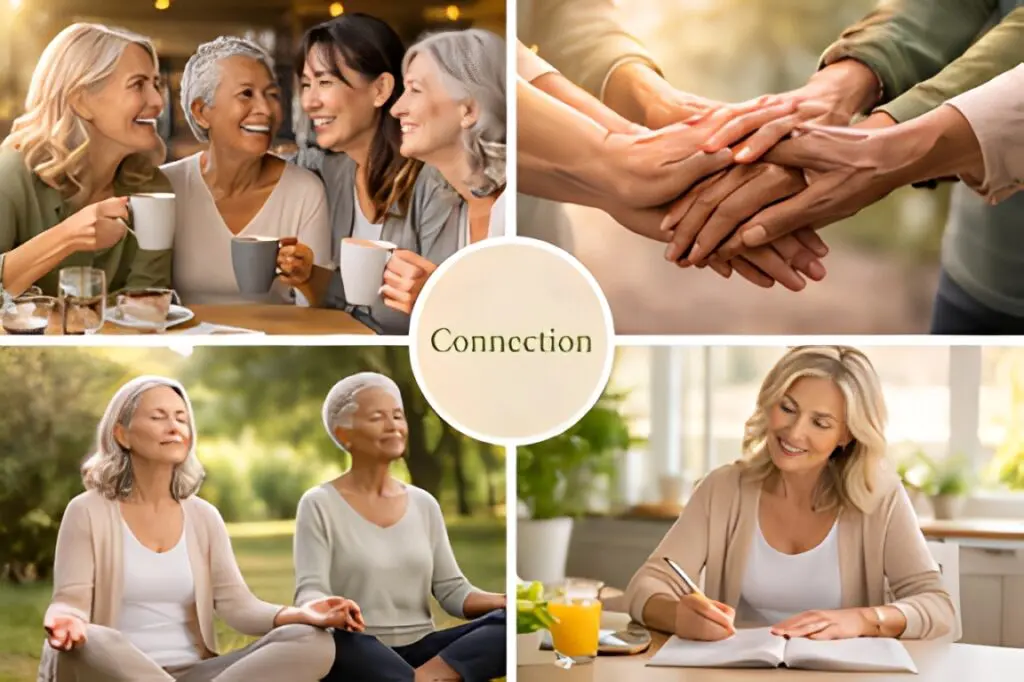
Community is the structure of your social world. It includes the groups you belong to and the people you regularly see. Book clubs. Volunteer organizations. Faith communities. Fitness classes. Neighborhood gatherings.
Connection is about depth and quality. It is feeling seen, understood, and valued. It is the difference between being surrounded by people and feeling truly connected.
You can have community without connection. You can show up, attend events, and still feel alone. That experience is loneliness. It is subjective and deeply personal. It is the feeling of lacking closeness or belonging, even when others are nearby.
The goal is both. Substance and Structure = Connection and Community.
Why This Matters Even More in Your Encore
Life changes as we age. Retirement reduces daily workplace interactions. Children move away. Friends relocate or pass on. Mobility or health challenges make getting out harder. Hearing loss can make social situations exhausting or frustrating.
Research shows that two-thirds of older adults experience age-related hearing loss, which is associated with a 28 percent greater risk of social isolation over time.
These are not excuses. They are realities. And they deserve to be acknowledged honestly and compassionately.
What I have learned from my own life is that no two women are alike in what they face or how they move through it. And yet, the common thread is powerful. We have far more in common than we have differences.
Bringing women together has become my purpose. It grew directly out of my own experiences. As I became more intentional about connection, a whole new world opened up. I feel more peaceful. More confident. More aligned with where I am headed.
I wake up every day feeling younger than my years, not because life is perfect, but because it feels meaningful. There is nothing I would rather be doing. That feeling is what I want to share.
Your Encore will not look like mine. It should not. But the process of becoming intentional about connection can be shared, adapted, and repeated in ways that honor who you are. Some of what has worked for me may resonate with you, and some may not. And that is exactly how it should be.
Within the BTGS Circle, there is wisdom to draw from, stories to learn from, and connections that can grow naturally when women come together with intention.
Small Steps That Make a Real Difference
Building community and connection does not require a dramatic overhaul. A little effort goes a long way, and the process will look different for everyone. The most important thing is finding what brings you joy.
Some possibilities include:
- Regular phone or video calls with friends or family
- Weekly coffee dates or walks
- Volunteering for a cause you care about
- Joining a book club, art class, or hobby group
- Attending religious or spiritual gatherings
- Participating in online communities with like-minded women
- Taking a class or workshop such as dance, art, music, writing, golf, tennis, or bridge
- Joining a fitness group or exercise class
- Becoming active in neighborhood activities
- Exploring the BTGS Circle
Being in a committed relationship or marriage is associated with slower memory decline in women. Living with others, engaging weekly in community groups, and maintaining regular contact with family and friends also contribute to better cognitive outcomes.
What matters most is that your connections feel meaningful to you.
Start where you are. If you feel isolated, one connection is a beginning. If you already have some social ties, consider deepening them. Quality matters more than quantity. A few meaningful relationships are far more supportive than a packed calendar that leaves you feeling drained or disconnected. We have all had those experiences that end with, “Well, I will never do that again.”
Balance structure and spontaneity. Regular commitments create consistency.
Being open to unplanned moments creates joy.
Technology can be helpful. The Conversational Engagement Clinical Trial found that regular internet calls reduced the risk of cognitive decline and social isolation among adults aged 75 and older. Video calls, texts, and online communities can bridge distance when in-person connection is not possible.
It is also important to acknowledge real barriers. If hearing loss is an issue, exploring hearing support can make social situations more accessible. If mobility is challenging, look for venues or online options that meet your needs. If finances are limited, libraries, senior centers, and faith organizations often offer free or low-cost programs. And just a reminder, continue to be intentional.
Just as we discussed in Part 1, community and connection do not simply happen. We create them, one choice at a time.
Beyond the Glass Slipper exists to support this process and to provide space for connection with other like-minded women. If it feels aligned, you are welcome to explore the BTGS Circle through the Connect page.
Two Main Parts of The Trifecta Yield Many Benefits
When community and connection work together, the benefits multiply. You have structure and meaning. Your brain stays engaged. Stress levels decrease. Your sense of belonging grows. Risks of cognitive decline, depression, and even mortality are significantly reduced.
This is not only about feeling good, though that matters deeply. This is about your health. Your brain. Your longevity. Your quality of life.
Encore Reflection: Journal prompts to get those cognitive sparks firing
- When was the last time I felt truly connected to someone? What made that interaction meaningful?
- In my current friendships, do I experience more community or more connection? Is there something missing?
- What barriers are getting in the way of building or maintaining a connection? What is one small step I could take to address one of them?
- If I could design my ideal social life for this stage, what would it include? Who would be part of it? How often would we connect? If you feel comfortable, sharing this reflection may help the BTGS Circle support you in making those connections.
Stay curious, see you next week, my friend.
Cindy
A Voice for Women in Their Encore.
If this resonated with you, stay a little longer. Listen to a podcast. Explore the Encore Brain Center. Try a Brain Spark. Join the conversation. Share with a friend – they will be glad you did!
References:
Social isolation risk comparable to smoking/longevity and mortality: Holt-Lunstad, J., Smith, T. B., & Layton, J. B. (2010). Social Relationships and Mortality Risk: A Meta-Analytic Review. PLOS Medicine.
Quality of social connections and physical health: Holt-Lunstad, J. (2018). Why Social Relationships Are Important for Physical Health. Annual Review of Psychology.
Loneliness and increased risk of cognitive decline and dementia: Livingston, G., et al. (2020). Dementia Prevention, Intervention, and Care: 2020 Report of the Lancet Commission. The Lancet.